
エコラベル
Ecolabels Overview
Products meeting EPEAT criteria are listed on the EPEAT online registry. Among the hundreds of environmental labels in the marketplace today, Type 1 ecolabels are recognized by the United Nations Environment Programme as the most reliable. Thousands of businesses, schools, hospitals and governments worldwide trust EPEAT to inform and streamline their purchase of sustainable technology products.
GEC believes there are important reasons why Type 1 ecolabels are considered the most reliable for public and private sector institutional purchasers.
Coming soon, the Global Electronics Council will launch an ecolabel covering electronic components.
Ecolabel Policies
The Global Electronics Council maintains policies, conformity assurance requirements, and internal procedures to support and govern programmatic activities for its ecolabels. These documents ensure GEC’s ecolabels continue to exceed the requirements of ISO 14024, the internationally recognized standard necessary for managing Type 1 ecolabels. The detailed policies for the EPEAT program are available here.
GEC has been audited by ANAB and received formal recognition for meeting the requirements of ISO 14024, the internationally-recognized standard for Type 1 ecolabels.
Registering Products

Manufacturers and/or brands interested in getting their products registered under one of GEC’s ecolabels first need to sign a contract with GEC, confirming that they will meet relevant policies. They must also choose a Conformity Assurance Body (CAB). CABs are third-party organizations that work with manufacturers to verify that their products meet the EPEAT criteria as claimed. Manufacturers interested in registering sustainable IT products and services through GEC ecolabels may choose to work with any existing CABs that work with their product categories. Download the GEC Participating Manufacturer Agreement for EPEAT. Further details on the EPEAT ecolabel’s verification process are available in the short education video below:
The Conformity Assurance Bodies providing third party verification services are experienced testing and certification organizations that must meet ISO/IEC 17020 Conformity assessment – Requirements for the operation of various types of bodies performing inspection or ISO/IEC 17065 Conformity assessment – Requirements for bodies certifying products, processes and services. GEC staff manage the CABs, making sure they maintain their required certifications, are trained on ecolabel criteria, and meet both technical and service performance requirements set by GEC.
See the Conformity Assurance Bodies (CABs) currently supporting GEC ecolabels.
To find out more about joining the EPEAT ecolabel, please visit the EPEAT Registry.
Conformity Assurance Bodies
Conformity Assurance Bodies (CABs) are experienced testing and certification organizations that work with manufacturers/brands to verify their product claims against ecolabel criteria. GEC staff manage the CABs, making sure they maintain their required certifications, are trained on ecolabel criteria, and meet both technical and service performance requirements set by GEC.
Manufacturers interested in registering sustainable IT products and services through GEC ecolabels may choose to work with any existing CABs that work with their product categories.
Companies interested in joining the network of GEC approved CABs, please contact us.
See the list of Conformity Assurance Bodies already approved to provide services for GEC’s ecolabels.
GEC CAB
The GEC CAB has supported EPEAT-participating manufacturers since 2006 and maintains rigorous accreditation to ISO/IEC 17020. It is particularly helpful to companies just joining EPEAT, as well as to small and medium companies with limited resources.
Click here for more information.
Criteria Development
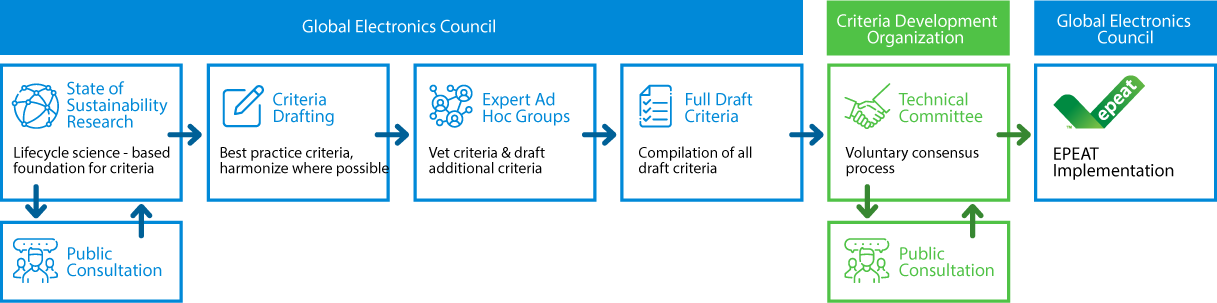
The Global Electronics Council is committed to developing lifecycle-based criteria through a balanced voluntary consensus process using an innovative process developed by GEC called the Dynamic Criteria Development Process (DCDP). The DCDP contains the five elements of a voluntary consensus process: openness, balance, due process, appeals process and consensus.
A summary of the DCDP and procedures governing the process are publicly available, as is the process GEC follows to select product categories.
Advisory Council
The EPEAT Advisory Council is a non-fiduciary body formed to provide input and advice to EPEAT management. The Green Electronics Council manages the EPEAT system. The EPEAT Advisory Council draws volunteers from all of EPEAT’s stakeholder groups, including representatives of manufacturing, purchasing, environmental advocacy, recycling, government, research, retail and reseller interests. Members are nominated for three-year terms. Each Advisor’s term expires in 12月 of the year indicated in parentheses shown.
The Advisory Council, whose members are shown here, meets twice annually in person and at least twice annually via teleconference. Subgroups of the Council also meet to discuss and develop proposals on specific issues as needed. The Council operates and makes decisions primarily through a consensus-based process. Nonmembers are welcome to attend meetings by invitation. Please contact EPEAT to make arrangements to attend a meeting.
Dave Asiello (2022)
Program Manager
U.S. Department of Defense
Blake Bennett (2022)
Corporate Governance and Stewardship
Janus Henderson Investors
Jenni Chun (2023)
General Manager of Regulatory Affairs
Samsung
Jeff Deeney (2022)
Product Environmental Stewardship
Hewlett Packard Enterprise
Karen Drozdiak (2023)
Manager of Sustainability Communications & Analysis
First Solar, Inc.
Charleen Fain-Keslar (2023)
Branch Chief, Procurement Division
State of California Department of General Services
Bill Hoffman (2023)
Senior Scientist
UL Environment
Stephanie H. Leclerc (2024)
Sustainable Procurement Project Manager
McGill University
Adam Rubinfield (2023)
Sustainability Manager, Corporate Procurement
World Bank Group
Nerea Ruiz (2023)
Senior Programme Manager
ECOS
Kyle Tafuri (2022)
Director of Sustainability
Hackensack Meridian
Lissa Wang (2022)
Compliance Manager
TPV/MMD
Fallight Xu (2022)
Manager Sustainability Services
TUV Rheinland